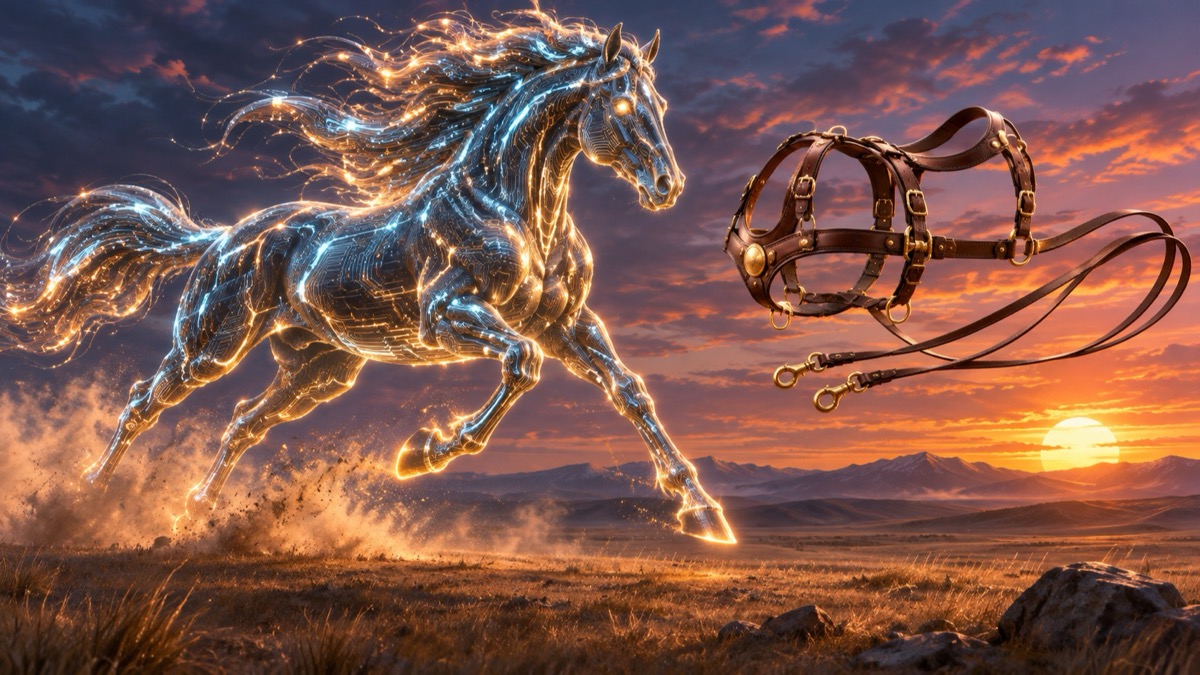
AI Has Become a Wild Horse: Who Holds the More Refined Harness?
The AI paradigm shift that turns uncontrollable potential into real value
Introduction: The Legacy of ‘Horsepower’ and Its Parallel in the Intelligence Revolution
The Industrial Revolution and the AI revolution line up exactly in one respect: both borrow the language of the past to define a new paradigm. In the 18th century, when the steam engine first appeared, humanity reached for its most familiar yardstick, the horse, to make sense of this strange machine’s enormous power. Even after cold metal engines took the place of flesh-and-blood horses, the word ‘horsepower’ (마력) survived, firmly entrenched as the standard for power output.
And now, in the middle of the intelligence revolution, we are witnessing another linguistic inheritance: the ‘harness’ (하네스, or 마구, the Korean word for horse tack), which has become the talk of today’s AI ecosystem. It suggests that we see AI not as a giant mechanical engine that spits out a fixed output for a given input, but as a living, breathing, bucking ‘wild horse that must be tamed.’
Development 1: A Wild Horse to Be Tamed, and the Harness as ‘Exoskeleton’
Today’s large language models (LLMs) are different from the software of the past, which moved only according to coded rules. They are more like a wild intelligence that thinks probabilistically within vast amounts of data and produces unpredictable results. Just as tack such as reins and a saddle is essential if you want to put a horse’s explosive muscle fully to work plowing a field or pulling a cart, a controlled environment called an agent harness is indispensable for applying AI’s potential to real business work.
If early prompt engineering was manual control, with a person holding the reins and tugging them this way and that, the modern harness is more than a restraint that holds the model down. It is an ‘interface’ and an ’exoskeleton’ that lets AI interact with external databases (RAG), search engines, and APIs. An AI fitted with a well-crafted harness has its vision corrected so that it doesn’t sink into the swamp of hallucination, and it is evolving into a ‘self-driving carriage’ that uses its own judgment as it runs along the track of defined business logic.
Development 2: The Age of the Multi-Horse Carriage, and the Nonlinear Leap Orchestration Creates
This powerful concept of the harness is now widening its view to multi-agent systems that overcome the limits of a single model. No matter how fine the steed, it cannot carry a heavy load across every stretch of rough terrain alone. Rather than relying on one giant general-purpose model, recent AI architectures are developing into a ‘multi-horse carriage’ (다두마차, 多頭馬車), hitching several horses with different specialties (specialized small models and the like) to a single carriage.
The most important element in this multi-horse system is orchestration: getting the horses to gallop flat out in the same direction without tangling their lines. The research agent fetches the latest data, the analysis agent processes it, and the review agent checks for logical errors, all keeping in step. When a system that governs this intricate teamwork is in place, we experience an explosive leap in productivity that goes beyond a simple arithmetic sum.
Development 3: The Circuit Breaker That Stops a Runaway, and the Human as ‘Final Coachman’
But when several wild horses interact with one another and pick up speed, there is one danger to guard against above all: the cascading-error phenomenon in which one horse’s small mistake leads to a ‘stampede’ of the whole carriage. A small hallucination by the research agent can snowball into a fatal logical error by the analysis agent.
To control this, an advanced AI harness must be designed with intelligent circuit breakers and, alongside them, the final coachman’s reins: human-in-the-loop (HITL). True control does not come from the human coachman interfering with every single step. Let the system run autonomously, but make it stop and wait for a human’s final approval only at the crossroads of important decisions or at moments that call for ethical judgment. That is the most refined form of reins we need to hold.
Conclusion: Beyond the Size of the Engine, the Refinement of the Harness Decides Who Dominates
Seen through this linguistic metaphor that runs through both the age of machines and the age of intelligence, we are now passing the most symbolic inflection point in settling wild intelligence into place as a practical tool for humanity. If ‘horsepower’ once symbolized the power revolution, ‘harness’ will go down in history as the word that stands for the direction in which the intelligence revolution was put to practical use.
If the early AI market was fixated solely on models’ parameter counts and muscle (performance), the rules of the game have now changed. The question is no longer simply how smart a model you have, but who will hold the reins of these enormous wild horses most flexibly and firmly, and drive them safely to the business destination. True dominance in the coming AI ecosystem will belong to those who design this refined ‘harness.’